
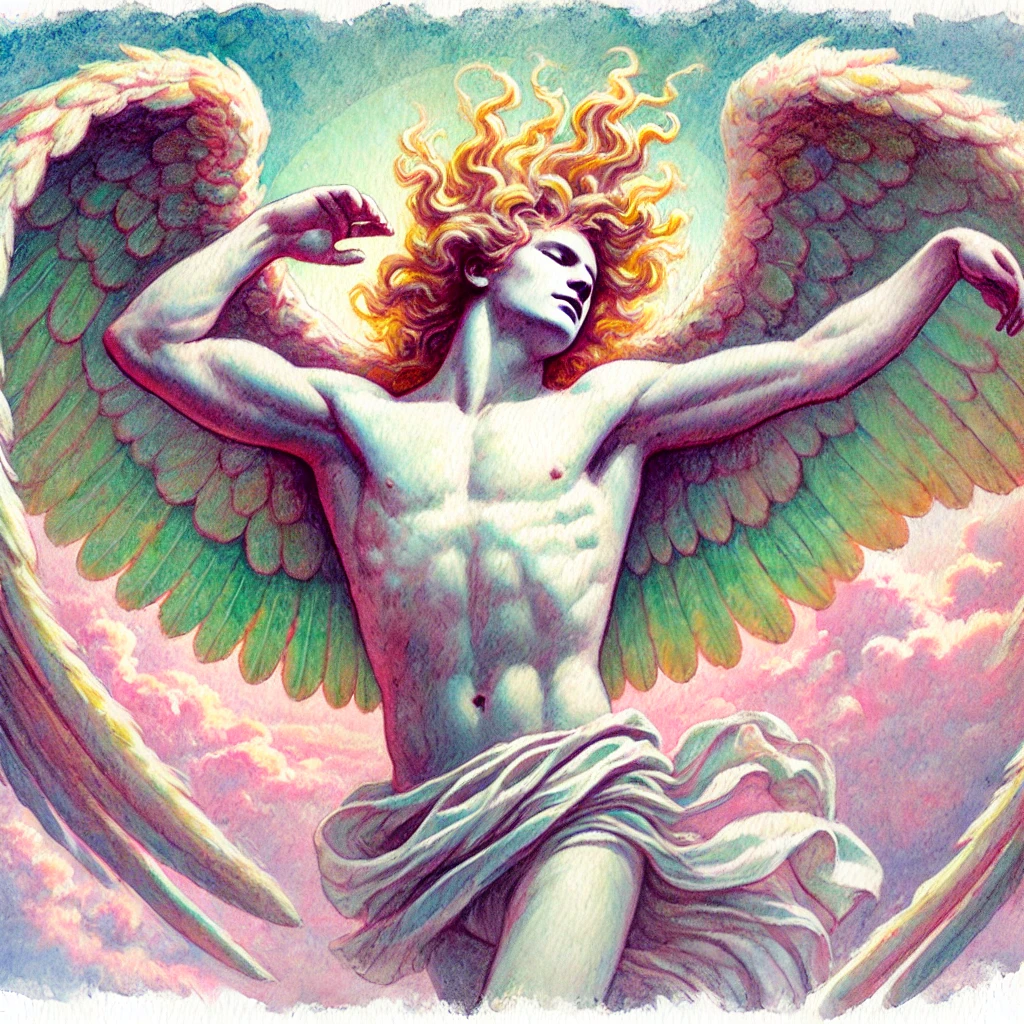
Caption: AI-generated idealised version of a painting I did on my bedroom wall at 14, inspired by Led Zeppelin’s Stairway to Heaven artwork. Sadly, no photo exists of this minor teenage ‘masterpiece.’ This rendering is inspiring me to get back to the drawing board with watercolour and coloured pencils eventually… maybe. 🤔
There’s a lady who’s sure all that glitters is gold…
At twelve, I was still immersed in the world of ballet, my hair tied back in a neat ponytail or flowing loose down to the middle of my back, I wore long flowing skirts and dreamt of the ghostly figure of Nijinsky—a man who seemed to hover between reality and the spirit world. He was everything I admired: ethereal talent, physical perfection, and a tragic genius that burned too brightly to last. Back then, I lived for the delicate beauty of ballet, captivated by its fragility and grace and my aspirations to one day reach perfection.
But that summer of 1981 which marked my twelfth birthday, everything shifted. That’s when I heard Led Zeppelin’s Stairway to Heaven for the first time (click on the link to listen). The opening notes, with that gentle recorder flute duet, felt like a doorway opening to another realm, and by the time the song ended, I wasn’t the same. It wasn’t just the music; it was something visceral, a physical pull that consumed me. Every note, every quaver in Robert Plant’s voice, felt like a secret being whispered to my soul. It was too intense to listen to often after that, but when I do, it sends me spiraling into a kind of ecstasy that borders on a manic high.
The lyrics were prophetic, though I didn’t fully understand them then, and I still don’t understand them now. They were about a lady buying a stairway to heaven, perhaps thinking money would bring her joy in the afterlife. It felt significant then, like it held a message for me. I never could articulate it, but hearing this song for the first time marked a turning point—a departure from the fragile world of ballet into something darker and more chaotic. Something I was not equipped for, no matter how mature I was for my age.
Later, in another city and another house, I painted the Led Zeppelin angel on my bedroom wall. Inspired by the band’s artwork, which was itself based on William Rimmer’s 19th-century painting Evening (The Fall of Day), the angel represented a kind of rebellion. My ballerina-themed room, with its pale pink and grey walls, was transformed with this first instance of rock imagery. The angel was huge, wings outstretched, a figure of both grace and power. Sadly, no photos of it exist, but the memory of painting it remains vivid—a declaration that I was no longer that young and innocent girl in ballet slippers.
By age fourteen, I’d fully transitioned out of the world of ballet, yet its echoes remained. My love for Nijinsky, the Ballets Russes, and the ethereal beauty of dance hadn’t disappeared—it had merely been overshadowed by my infatuation with heavy metal. But I didn’t fully belong to either world. Ballet was too rigid for my free spirit, and the rock scene too wild for my introspective nature. I was always in between, caught in the in-between space where the angel on my wall seemed to reside.
Years later, I saw a modern ballet performance called Requiem by Les Grands Ballets Canadiens. I went with high expectations, hoping to rekindle some of that old magic. Instead, I found myself deeply disappointed. The performance was drab, the dancers crouching and shuffling, their movements seemed to me to be devoid of the grace and beauty I’d always associated with ballet. It was a stark contrast to the ethereal world I’d once worshipped. I almost walked out, disillusioned and saddened by what ballet had become in its modern iteration.
Still, the power of Stairway to Heaven remains. Even now, when I hear it, I’m transported back to that summer of my twelfth birthday, to the moment when I first felt the pull of something greater than myself. The angel on the wall, Nijinsky, the song—they’re all pieces of a puzzle I’ve spent my life trying to fit together. And maybe, just maybe, they’ll find their place in my story yet.
Invisible Wings and the Flight of Madness
Nijinsky was a legend in his day, known for his gravity-defying leaps. Audience members swore they saw him hang in the air, as though he had invisible wings. He embodied perfection and something transcendent, like a divine being temporarily bound to earth. Those leaps mirrored the way Stairway to Heaven makes me feel—as though I’m flying, weightless, untethered from reality.
The guitar solo in Stairway hits me like a bolt of lightning every time. Jimmy Page’s playing isn’t just music; it’s a direct line to something unexplainable. It makes me want to fly. It’s a visceral, physical reaction—an ecstatic moment that is frightening in its intensity.
I’ve always felt like I existed between two worlds, never quite belonging to either. The perfection of ballet, with its rigid discipline and ethereal grace, felt just out of reach, while the raw, chaotic energy of rock was too wild for my introspective nature. But the angel—that angel I painted—was a bridge. It was both fragile and powerful, a reflection of my own inner world.
The recorder duet in at the beginning of Stairway ties it all together, echoing the music appreciation classes I loved as a child. The delicate, haunting notes of the recorder feel like whispers from another time, another place—a reminder of the ballet studio, and of my first steps into a world where art could transcend reality.
The Lyrics and Their Prophecy
“There’s a lady who’s sure all that glitters is gold…” That line always struck me as profoundly sad. The lady is chasing fool’s gold, believing in a dream that may not deliver. The lyrics, with their layered meanings, felt like a prophecy—a warning, perhaps, about the paths we choose and the illusions we cling to. To me, they mirrored my own journey, my constant search for something beyond the mundane, even if it meant losing myself along the way.
Ultimately, Stairway to Heaven isn’t just a song. It’s a portal to another dimension, a map of the unknown, and the other side of the mirror. It reflects the longing, the ecstasy, and the madness of trying to find meaning in a world that often feels too small. And it reminds me that, like Nijinsky, I’m always striving for that moment of flight—even if I never quite touch the heavens.

Nijinsky by Auguste Rodin


 Totally Surreal
Leave a reply to Smiler Cancel reply