

Metro Series No. 11 – Jonathan Strange
Pencil on paper
This piece is part of my Metro Series, a collection of hyperrealistic drawings I started in 2015, capturing quiet moments in the Montreal metro. Unlike most of the series, this one features a subject who posed for me with permission—Elissa Baltzer, a fellow artist and life model at the time. Ironically, because I had her explicit consent, I can share this work without legal concerns. But for the majority of my Metro Series, the same cannot be said.
Drawing to Connect
I started this series at a time when I was deeply vulnerable, with an immense need for human connection—but on my own terms, in a way that felt safe. Drawing these strangers in the metro allowed me to exist among them, to capture something intimate without intrusion, and to get close to them in the safety of my own home. These portraits were never about objectifying or exploiting; they were my way of reaching out, of finding meaning in fleeting encounters and transforming them into something lasting. In a way, they became visual poems—moments of stillness in an otherwise chaotic world.
So far, Metro Series consists of 15 pieces, including one in watercolour and one in pen and ink, completed in October 2022. Each piece represents a different moment, a different subject, but together they form a cohesive narrative about urban solitude, presence, and connection.
The Search for a Solution
For nearly a decade, I’ve reflected on how I could adapt these works to comply with the law while preserving their essence. I explored ways to subtly change the faces to protect anonymity. When I reached out to a local artist for advice, she suggested an intriguing idea: replacing the faces with my own. The concept was fascinating—a way to subvert the law while still preserving the original intent of the series. But ultimately, it felt disconnected from the core of the work. After this deep dive, I came to a clear realization: the problem isn’t my drawings. The problem is the law.
I believe Metro Series is worth making a case study of—an example of why this law needs to change to allow for true creative freedom again. Artists should not have to distort their work just to comply with a flawed legal framework. Instead, the framework itself should be questioned, challenged, and reformed.
When the Law Works Against Art
Quebec’s right-to-image laws are some of the strictest in the world. Originally intended to protect privacy, these laws now extend to artists like myself, preventing me from publicly exhibiting or publishing works featuring real people—even when those works are hand-drawn. The logic is flawed: a photograph captures an exact moment, while a drawing is an interpretation, filtered through the artist’s eye, hand, and mind. And yet, the law makes little distinction.
This has had disastrous consequences for documentary photographers, street artists, and anyone working in portraiture. Visual archives have been blurred or destroyed. Creative expression has been boxed in by bureaucracy. And in my case, Metro Series, a body of work that took nearly a decade to complete, sits largely unseen—not because it is exploitative, but because it is too accurate.
What’s at Stake?
This isn’t just about my work. It’s about what happens when laws meant to protect individuals start erasing culture instead. The everyday faces of a city, the fleeting moments of life on public transit—these things matter. They tell a story about who we are, where we live, and the time we exist in. Without artists being able to document them, something vital is lost.
Should artists be held to the same standards as photographers when the creative process is inherently different? Should laws that protect individuals from exploitation also suppress artistic expression? And at what point does protecting privacy become an excuse for censorship?
I don’t have the answers yet, but I know this: Metro Series deserves to be seen. And this conversation needs to be had.
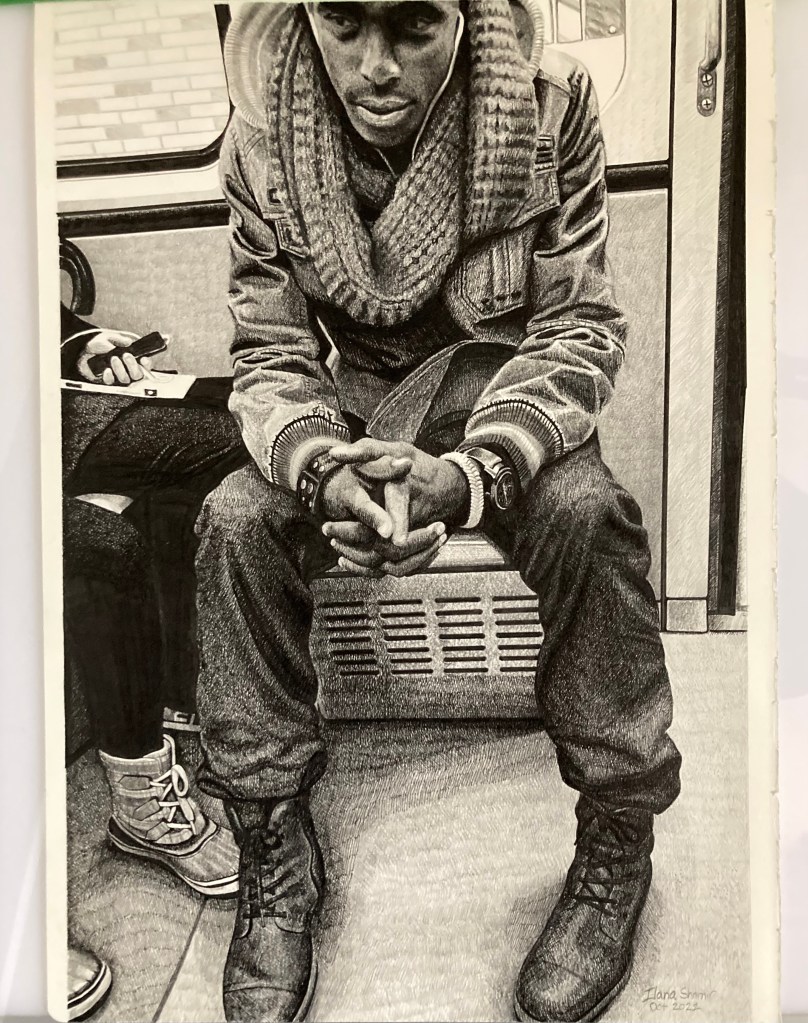
Metro Series No. 15 (Pen & Ink, October 2022)
This piece was an experiment in persistence. I started the drawing, wasn’t happy with it, started over on a different paper, struggled with contrast, and then picked up a pen—immediately convinced I had ruined it. I kept working, sure I was overworking it, and somehow, this is what emerged. Sometimes, what feels like “too much” is exactly what’s needed.
- Rebuilding the Codex Drawing Series
- How AI is Shifting our Language
- Marker Study No 2
- A Quiet Pencil Study
- Survivors


 Totally Surreal
Leave a reply to maxfrancesartist Cancel reply