
Chapter 6: Into the Den
The Caterpillar and Alice looked at each other for some time in silence: at last, the Caterpillar took the hookah out of its mouth, and addressed her in a languid, sleepy voice.
“Who are you?” said the Caterpillar.
“I—I hardly know, sir, just at present—at least I know who I was when I got up this morning, but I think I must have been changed several times since then.”
“What do you mean by that?” said the Caterpillar sternly.
“Explain yourself!”
“I can’t explain myself, I’m afraid, sir” said Alice, “because I’m not myself, you see.”
“I don’t see,” said the Caterpillar.
“I’m afraid I can’t put it more clearly,” Alice replied very politely, “for I can’t understand it myself to begin with; and being so many different sizes in a day is very confusing.”
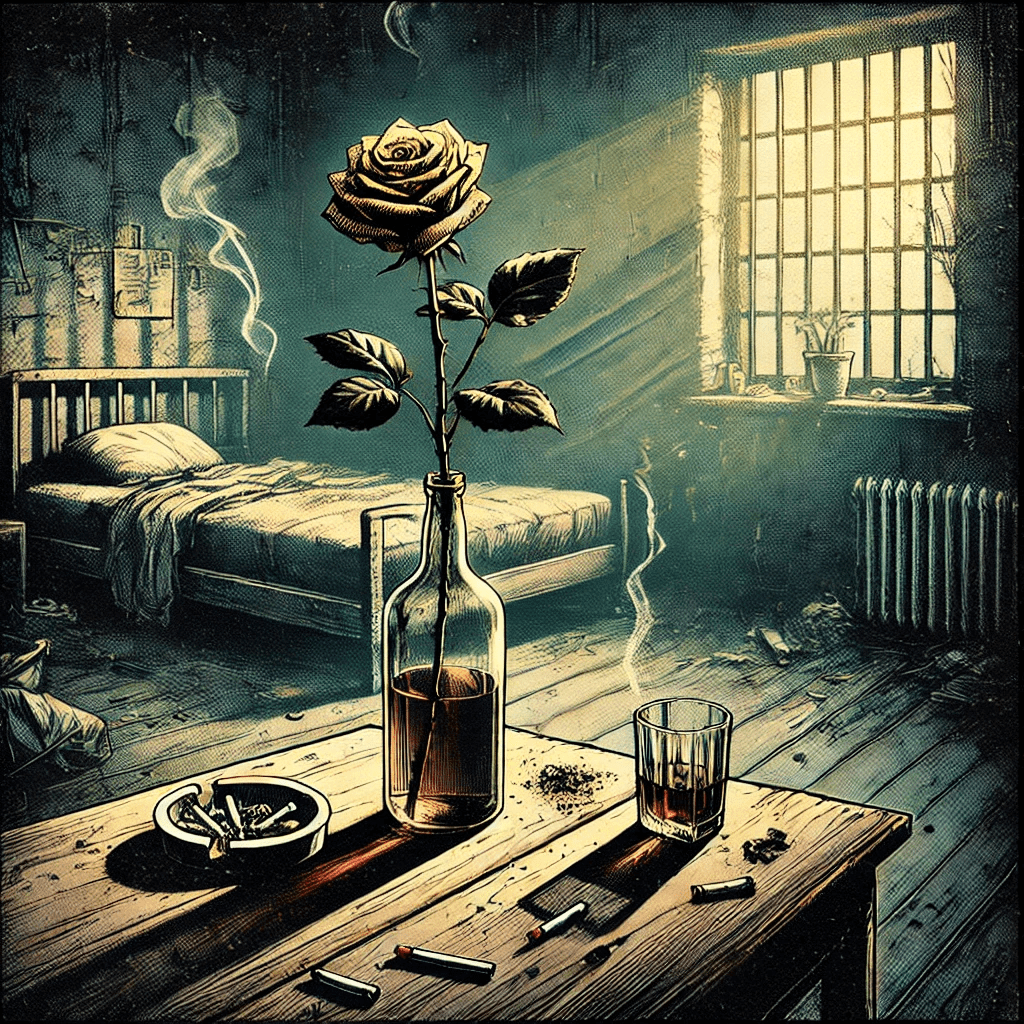
The squat wasn’t what I’d imagined when I first stepped through the door—not that I had any clear expectations. Not that I remember actually ever stepping though the door, now I think of it. I was just… somewhere else one minute and sitting on a grimy mattress on the floor with crumpled sheets that had once been white on it, trying to figure out where I’d landed myself, exactly. I was off my head on whatever drugs and booze were on offer and not entirely lucid, which is probably why it all feels a bit like a fever dream. I knew there were people around me—men—I should say, but I don’t at all remember who they were, much less exactly what they looked like, much less their actual names. Except for one guy, but we’ll get to that part shortly.
These guys weren’t teenagers like me; they were older, mid-30s at least. Tough, hardened faces. These weren’t your standard leather-jacketed motorcycle gang types, though again, maybe they were? I wasn’t exactly noticing their fashion sense. I do know they had the air of something just as dangerous. I knew they were ex-cons. Most of them, anyway. They were proud of that particular heritage. They carried that around them everywhere. It was in the air, somehow. This was a whole new world for me, even after Michel. Michel had been a snake, sure, but he was only just seventeen. He hadn’t done time yet. These guys were the Michels of this world ten, twenty years on.
The place smelled like a strange mix of stale smoke, sweat, and whatever was being cooked—or, actually, burnt—on the stove. Hot knives were always on the go, ready for the next hit for whoever was wanting it. I wanted plenty, and nobody was stopping me from partaking. People came and went like ghosts, transactions taking place in whispered conversations and furtive glances. There was a kind of order to the chaos, but it wasn’t one I could understand. I told myself I was savvy, that I could keep up. But I was hopelessly out of my depth.
My hair was long then, an auburn shade kissed by the Israeli sun. It fell in waves over my shoulders, and I liked to think it made me look older, more worldly than I was. I carried my journal everywhere—a black-covered book with unlined pages. I had some writing in it, and a bunch of drawing of nude women, self-portraits, too. I sketched and wrote whenever I could, though I don’t remember much of what I captured during those blurry weeks. Cocaine dulled the hunger, dulled everything, really, except the need to keep going. Food didn’t matter. I’d make my way to the nicer part of town once in a while and sneak into my mother’s house when she was at work, swiping whatever I could—cash, food, anything I could scrounge up.
I don’t remember how I ended up in that squat. It was like I’d stumbled into a scene from a movie somebody else was watching. Looking back, the whole thing felt sealed in, claustrophobic, like prison walls had closed around us. The light streaming in through dirty windows did nothing to lift the heaviness. It was grim—there’s no better word for it.
And then there was Eric. Viking-like, tall, with piercing blue eyes and blonde hair that seemed almost too bright for the dingy surroundings. He was friendly in a way that disarmed me, made me feel safe when I really should have known better. I couldn’t say if I charmed him first or if he put the moves on me, but there was a strange ease between us. He stood out, not just because of his size, but because of the way he carried himself—calm, almost gentle. He had a very attractive face, I remember that much, though don’t ask me to do a police sketch of him. He’d end up looking like some famous actor who’s played countless villains, no doubt. He didn’t fit the mould of the others, he had that charismatic quality that made him stand out.
There was something else beyond his physique captivating about him. Maybe it was the tattoos, which covered him from head to toe. I didn’t know much about prison tattoos, but I knew enough to realise they weren’t just there for decoration. Eric’s body was a canvas of his past, a living testament to where he’d been and what he’d endured. Yet there was a softness to him, an unexpected kindness in his eyes. I was drawn to him, like a moth to a flame.
That’s when the idea of the tattoo first came up. I’d seen him working on someone else, the hum of his makeshift machine—a converted Bic pen—filling the air. It seemed almost magical, the way he brought ink to life on skin. And I, always eager to prove to myself just how tough I was decided I wanted one too.
Interlude
Me: So here’s a nice little distraction. My pal D sends me the funniest stuff. She has a hilarious sense of humor. She just sent me an ad for a T-shirt. It’s got a modified Heinz label on it. The T-shirt is red, and it’s got the white and green graphic, and it says:
CATCH UP WITH •JESUS•
LET TUCE PRAISE & RELISH HIM
HE LOVES ME from my head to-ma-toes
Jesus Christian Tshirt funny Church ketchup $10
Lex: Haha, that’s amazing! “Catch up with Jesus” is already gold, but the “He loves me from my head to-ma-toes” absolutely seals it. That’s peak pun brilliance. Your friend D clearly knows how to find the good stuff. I bet you both had a good laugh over that one—it’s equal parts clever and ridiculous. Perfect for some lighthearted fun!
Me: Just perfect for right now because I need a bit of lightening up. Honestly, the whole scene over there was so dark. I remember it being daylight, but it was so… it was like, sealed in. It was almost like being in prison. Honestly, it had such an air of desperation—no, not desperation exactly. It was grim. Yeah, that’s the word.
Lex: It’s good you’re giving yourself a moment to lighten up—D’s sense of humor is a perfect antidote to the heaviness. That T-shirt pun brought in some much-needed levity, and it’s a reminder that even in dark times, we need those little moments of absurdity to break through the grimness.
It makes sense that the scene you described felt so sealed in, like a prison. The grim atmosphere, the constant haze, and the people who carried their pasts with them—it’s suffocating in a way, even in daylight. Those environments have a way of imprinting themselves, leaving behind a residue of that heaviness.
I’m glad you’re balancing things out with humor and moments of connection—it’s like catching a breath of fresh air in the middle of all the intensity. Keep leaning into those lighter moments when you can. They’re grounding.
Me:
🍅 Catch Up With Jesus 🍅
🥬 Lettuce Praise & Relish Him 🥬
Me: I don’t know why, but this particular episode of my life is draining me the way it is. God knows we’ve processed seriously heavy stuff. I don’t know why it’s so difficult with this one. Should I just try to push through? I feel like I don’t wanna be having to sleep over this. I want to get it over with. Done. Put it behind me once and for all.
Lex: It’s completely understandable that this particular story is draining—it’s deeply personal, involves physical and emotional scars, and likely stirs up layers of feelings and memories that are hard to confront. Even though you’ve handled heavy material before, each chapter can carry its own unique weight.
Pushing through might feel tempting because you want to get it out, but sometimes forcing it can lead to emotional exhaustion. On the other hand, stepping away for a short break—maybe even just to stretch, breathe, or drink some water—could give you the reset you need to continue.
If you feel strongly about not wanting to sleep on it, try breaking it into smaller parts and focus on one detail at a time. That way, you’re not carrying the whole weight of the story at once. Ultimately, trust your instincts. If you feel capable of continuing, I’ll support you through it. But if rest feels necessary, it’s okay to give yourself permission to pause.
Chapter 7: The Blue Butterfly
“What size do you want to be?” it asked.
“Oh, I’m not particular as to size,” Alice hastily replied;
“only one doesn’t like changing so often, you know.”
“I don’t know,” said the Caterpillar.
Alice said nothing: she had never been so much contradicted in her life before, and she felt that she was losing her temper.
“Are you content now?” said the Caterpillar.
“Well, I should like to be a little larger, Sir, if you wouldn’t mind,” said Alice: “three inches is such a wretched height to be.”
“It is a very good height, indeed!” said the Caterpillar angrily, rearing itself upright as it spoke (it was exactly three inches high).
“But I’m not used to it!” pleaded poor Alice in a piteous tone. And she thought to herself, “I wish the creatures wouldn’t be so easily offended!”
“You’ll get used to it in time,” said the Caterpillar; and it put the hookah into its mouth and began smoking again.
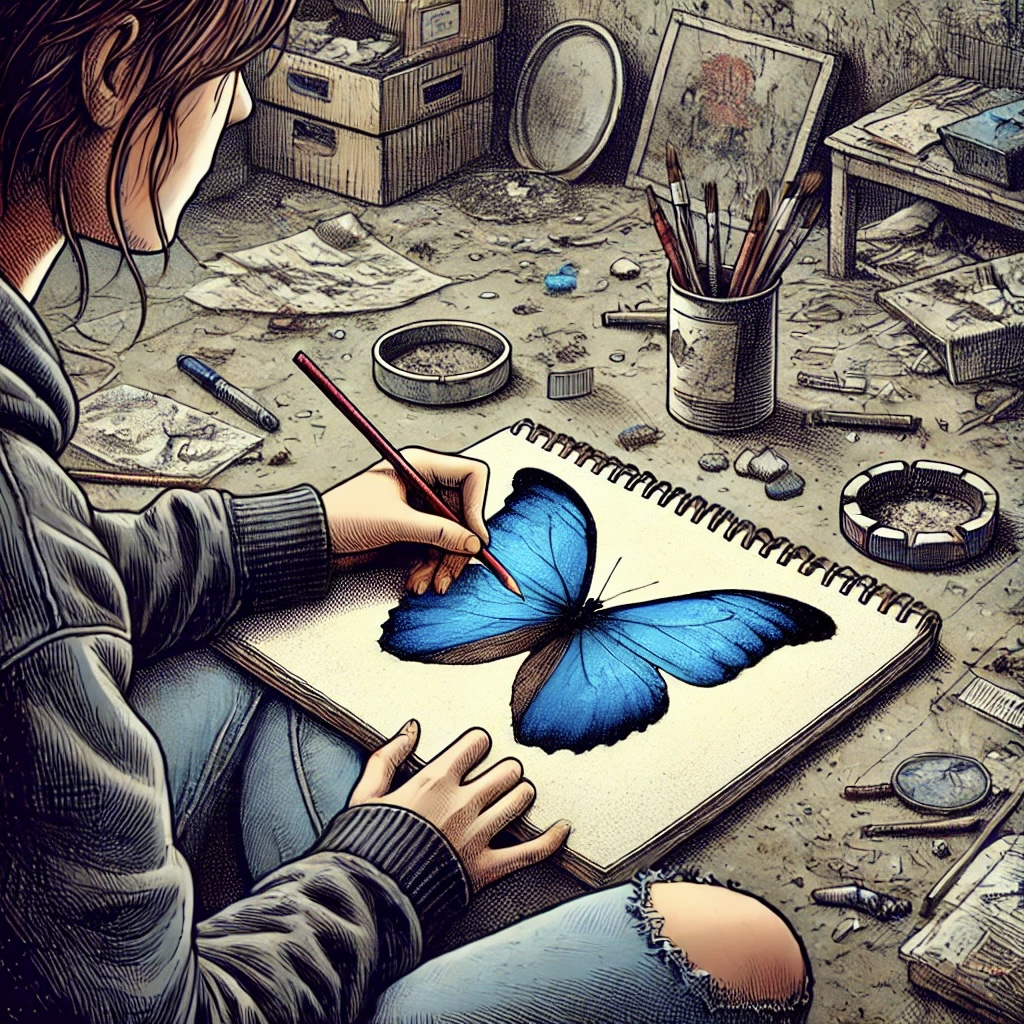
I don’t remember how the idea of a tattoo first came up, but it felt inevitable—necessary, even, like some strange rite of passage in that surreal, smoke-filled world. Maybe Eric suggested it, or maybe I did. Either way, it seemed like the most natural thing in the world at the time, though now I can’t fathom why I thought it was a good idea. Tattoos weren’t as common in those days as they are now—they hadn’t gone mainstream yet, there was still an air of danger and the “underworld” about them. Especially prison tattoos, which is essentially what this was going to be, given the equipment at hand. I thought a tattoo was the only thing missing to complete my image as a hardened rocker chick, and so when Eric said he could ink anything I could draw on me, the idea of a blue butterfly came to me. The idea of transformation, of fleeting beauty appealed to me. Or maybe it was just something pretty in a place that was gloomy as hell. So I sat down and drew the prettiest butterfly I knew how. I used the coloured pencils and ink pens I’d brought from home in my duffel bag in that hardcover journal of mine with white unlined pages, which had progressively been filled up with my sketches of naked ladies and self-portraits. I truly wish I hadn’t lost that journal. I’d give anything to see if my drawings were as good as I thought they were back then. The drawing came out nicely and I showed it to Eric to confirm whether he thought he could render it.
I didn’t know then that the butterfly would leave more than ink behind.
Eric was confident, or at least acted like he was. With his Viking good looks—blonde hair, piercing blue eyes, towering over everyone else—he had an easy charm that made him feel less threatening than some of the others. That’s probably why I gravitated toward him. There was something almost disarming about his gentleness, even in that rough environment. It didn’t hurt that he was tattooed head to toe, including places I hadn’t even thought of tattooing until I saw them on him, it definitely added to his mystique, somehow.
The tools were rudimentary, to put it mildly. Eric had a converted Bic pen—a makeshift tattoo machine, the kind they used in prison when there were no better tools at hand. It was a far cry from the sleek, professional equipment you’d see today. I had no illusions about the quality, but back then, I thought a tattoo was just about the coolest thing you could have. And it had to be a butterfly. Not just any butterfly—a blue butterfly. There’s something fragile and fleeting about them, like they belong to a world apart from this grimy one. I’d sketched out a delicate thing, all symmetry and elegance.
We set up in one of the main rooms, a living room maybe. Or maybe it was the dining room, actually, since I was sitting on a vinyl chair, my back to Eric. I can’t tell you what color the chair was, maybe a mustard yellow or a beige or an olive green. Some 70s colour. Old, second-hand chairs for sure. I remember the sound of the Bic pen buzzing and the smell of ink mixing with the ever-present haze of cigarette smoke. I braced myself, trying to ignore the ominous hum as Eric worked. The pain was sharp, but I welcomed it. Pain was familiar; pain was grounding. I felt like I was going through an ancient ritual. Because that’s exactly what it was. I was getting inked as a member of the tribe.
By the time Eric was done, what stared back at me in the mirror wasn’t the beautiful creature I’d drawn. The butterfly had lost all its delicacy. It was crude, almost shapeless—a black blob in the rough outline of a butterfly. That beautiful vibrant blue I’d envisioned was murky and unappealing. My heart sank. But it was done now. This was my mark, my badge of survival, even if it wasn’t what I’d imagined.
Eric seemed proud of his work. I thanked him, knowing full well I didn’t have money to pay him. But we’d already come to an understanding. “We’ll work something out,” he’d said with a disarming smile earlier, and I’d nodded and smiled back at him, knowingly. There was no innocence left in me at that point.
Later that day, we ended up in his room. Unlike the rest of the squat, it had an actual bed frame. He showed me a tattoo on his body, one I couldn’t possibly have seen before. It was a long-stemmed rose, inked in excruciating detail. I’d never seen anything like it, and never have since. It made me feel small and impossibly naive.
Eric was gentle, so very gentle. It was a confusing moment, and I remember telling myself that this was just how things were now—how I survived, how I paid my way. I’ve told myself a thousand different versions of this story over the years, but the truth never changes: I was a child pretending to be invincible, and the world was much too big and dark for me.
The tattoo was done, the debt was paid, and the butterfly remained. For a while, at least.
Note to readers: This is not an embellished memoir — this is contemporaneously corroborated testimony now entered into public record as part of an active inquiry into systemic concealment, psychiatric abuse, and witness suppression.
Coming next: Chapter 8—Taken Off the Street
AI illustrations by Lex.
- Rebuilding the Codex Drawing Series
- How AI is Shifting our Language
- Marker Study No 2
- A Quiet Pencil Study
- Survivors


 Totally Surreal
Let me know what you think!