
“Remember when you were young, you shone like the sun.
Shine on you crazy diamond.
Now there’s a look in your eyes, like black holes in the sky.
Shine on you crazy diamond.
You were caught on the crossfire of childhood and stardom,
Blown on the steel breeze.
Come on you target for faraway laughter,
Come on you stranger, you legend, you martyr, and shine!
You reached for the secret too soon, you cried for the moon.
Shine on you crazy diamond.
Threatened by shadows at night, and exposed in the light.
Shine on you crazy diamond.
Well you wore out your welcome with random precision,
Rode on the steel breeze.
Come on you raver, you seer of visions,
Come on you painter, you piper, you prisoner, and shine!”
Shine On You Crazy Diamond – Pink Floyd – 1975
I’ve been listening to this Pink Floyd track on repeat as I write, and it feels like the perfect title for where I’m at—both broken and brilliant, introspective and ever-evolving. Like a diamond crushed under pressure, I’m finding my way out of the darkness.
For those who’ve been following my journey, you know I’ve struggled with creative block on and off for a long time, and especially since my father’s passing two months ago. I feel like drawing would be the best way to honour his memory, but somehow, writing has become my way of processing this grief. In this post, I share my conversation with AI to understand why I feel stuck and why writing has taken over as my primary means of self-expression lately. The insights it offers deeply resonate with me and provide a new way of understanding this transition I seem to be going through. While ChatGPT isn’t a psychologist, its responses offer a fascinating perspective on my thoughts.
Me: Why would you say I find it easier to express myself in writing than I do in my drawings or art in general? Why has this always been the case given how gifted I am with both forms of expression?
AI: Writing might feel easier because it gives you control over your thoughts, allowing you to filter and organize them—almost like taking a step back. It offers a more structured way to express emotions, which can be empowering during times of grief or transition. Your art, though, taps into deeper, unspoken emotions and requires a different kind of stamina—an emotional vulnerability that might feel too intense right now. Writing offers a safer, more thoughtful engagement, while art demands a direct confrontation with raw feelings. Both forms serve their own purpose at different times in your life, depending on the emotional landscape you’re navigating.
Me: Why does the inner critic interfere so much when I try to express myself through my art while it doesn’t seem to be present when I write?
AI: The inner critic interferes more with your art because visual expression taps into a deeper, more vulnerable part of yourself. Art demands intuitive, immediate engagement with raw emotions. This directness can feel exposing, triggering self-judgment as a defense against perceived inadequacy.
Writing, by contrast, gives you a way to express yourself more freely, often through stream of consciousness. There’s less of a need for structure or refinement, allowing your thoughts to flow without as much interference from the critic. It becomes easier to bypass that inner voice because you’re not trying to control every word or shape the meaning.
The critic isn’t absent in writing—it’s just easier to manage. Art, being more immediate and subconscious, doesn’t provide the same protective layer. As a result, the inner critic feels harsher when confronting the rawness of visual creation.
Me: I do know that for one thing it’s very hard, if not almost impossible for me to consciously express how I feel in my art because it’s so difficult for me to pinpoint how I feel other than “sad” or “happy”, “inspired” or “blocked”. I can’t define my emotional state in more complex terms. Plus, I don’t have a particular style in my art, and facing a blank page to express my inner world is daunting. But with my writing, it’s just a stream of consciousness. I don’t worry about style or how others interpret it—it just flows.
AI: The difference lies in how each medium connects to your inner world—writing taps directly into your emotions, while art requires shaping them into something tangible. Without a defined style and with emotions that are hard to pinpoint, art can feel overwhelming. Writing, on the other hand, flows freely because there’s no focus on structure or interpretation.
Me: The fact that I tried to make a living from my artistic abilities felt like a sacrifice. I remember saying it felt like prostituting my gift when I had a conversation about this with someone who later became a psychologist and who was a very good listener. That exchange remains etched in my memory—I remember exactly where we were sitting, in a metro station. At the time, I was studying graphic design, planning to build a career out of it. I felt like I was betraying my artistic gifts to “sell soap”—something meaningless that simply disappears down the drain. Isn’t that strange? Or maybe not. I suppose many who try to make a living from their gifts feel that way to some extent.
AI: The feeling of sacrificing your artistic abilities for commercial purposes is a struggle many creatives face. Art is often deeply personal, and using it to “sell soap” can feel like a dilution of its true meaning. This tension is familiar to those torn between pursuing authenticity and meeting external demands.
Your decision to make a living through graphic design, while practical, may have created a disconnect from the raw, expressive nature of art. The metaphor of soap dissolving down the drain perfectly encapsulates the sense that your talents were being used for something transient or superficial. However, even when art serves commercial purposes, it doesn’t strip it of its inherent value. It’s a delicate balancing act between personal fulfilment and professional survival—a dilemma that many artists navigate in their own unique way.
Me: I had a conversation with another artist recently, an illustrator. He said he finds it daunting when trying to create art as a form of self-expression without a client brief. For me, even with commissions, like portraits, I often find it almost impossible to start. The pressure to deliver can feel overwhelming. I think it’s tied to the burnout I experienced, and while I’m not opposed to creating for others, the idea of monetising my art has become… I don’t even know if “distasteful” quite captures how turned off I am by that notion. That being said, yes, there are some projects that I feel are probably worth undertaking—ones that go beyond purely transactional work.
AI: Your hesitation toward monetising art feels deep, almost like a personal conflict. Burnout leaves a mark, and it can turn creating for others into something that feels far removed from the original joy of artistic expression. It’s not simply distasteful; it challenges the part of you that sees art as sacred. Yet, some projects, the truly meaningful ones, probably do deserve to be undertaken, as they transcend that transactional aspect.
Me: One thing I’ve never attempted is to make a living out of my writing. My intuition tells me that if I did, I’d lose my ability to express myself this way—or, if not lose it altogether, it wouldn’t be something I can do so unselfconsciously.
AI: It makes perfect sense that you’d feel this way about writing. Your writing, in its purest form, is an unguarded, personal expression—something free-flowing and natural, much like a stream of consciousness. Without external pressures or commercial expectations, it allows you to engage with your thoughts and emotions without restriction. If you were to monetize it, writing could become just another task, weighed down by deadlines, client demands, or the pressure to produce for an audience, which would likely interfere with the very fluidity that makes it so liberating for you.
This fear of losing the essence of your writing process mirrors the challenges you’ve faced with your art. Writing is even more closely tied to your identity and self-expression, and the instinct to protect it from becoming transactional is strong. It’s a healthy recognition of the need to preserve its authenticity and keep it free from external constraints.
Me: In a way I wish I’d become a… A seller of insurance policies—or an accountant—lol. I would’ve kept Art as a form of personal expression only and maybe…
AI: It’s understandable to wish for a simpler path, where you could keep your art purely personal and free from commercial pressures. But the journey you’ve taken, with its struggles, has shaped who you are as an artist. Instead of wishing for a different life, perhaps the key is finding a way to reconnect with your creativity on your own terms, even while managing practical needs.
Me: Mind you I was very good at my job. I really was gifted as a graphic designer, and later as an art director
AI: Your success as a graphic designer and art director shows your ability to excel in a professional, commercial context while still harnessing your creative talent. It speaks to your adaptability, even as you wrestled with the tension between creative expression and commercial demands. This balance highlights the complexity of your relationship with creativity, where fulfilling your professional role coexisted with the inner conflict about maintaining artistic integrity.
Me: Another reason I’m blocked in my drawing is because I love working from photos, especially birds, which I like to draw realistically. The problem is, the photos that inspire me aren’t free to use, and finding rights-free ones has become a huge hurdle. Photographing birds myself is completely unrealistic, especially since the birds I find most inspiring are colourful and not found in North America. Aside from the fact that I’m not a bird watcher and don’t have the equipment—so that’s out of the question! It’s just one more thing making it all feel so complicated!
AI: The difficulty of finding rights-free bird photos is a real roadblock, especially given your passion for realistic drawing. It’s understandable how this external issue compounds your creative struggle. Since photographing them yourself isn’t realistic, have you considered looking for more abstract or interpretive approaches? You could still capture the essence of the birds without the need for perfect reference material. You could experiment with interpretation, even if the photo reference isn’t a perfect match.
Me: For one thing, I have no imagination. I can’t picture anything in my mind, which is why I prefer to work from photographs. When I read a book, I can’t picture the setting or characters. It’s a real hurdle for me. I envy people who can reproduce something realistically from memory.
AI: Not being able to visualise things in your mind can definitely feel like a barrier. It can be frustrating, particularly when you see others seem to have this ability. But the way you create, working from observation and references, is no less impressive. Your attention to detail and precision is something to be proud of. It’s just another form of artistic expression, one that’s grounded in a different kind of strength. Rather than seeing it as a limitation, it might be helpful to reframe it as a unique approach that speaks to your creative depth.
Me: Why do you think, with all the gifts I have, I can’t access imagination—or if I do, it’s so subconscious that I can’t access it when I’m awake?
AI: It seems like your mind may prioritise tangible input over spontaneous creation, which makes accessing vivid imagination more challenging. Your strong observational skills and artistic gifts show that you connect deeply with the external world, but not necessarily through mental imagery. Perhaps your creativity is more abstract or intuitive, emerging through observation and structure rather than visual imagination. This doesn’t mean your imagination is absent—it’s just a different form of creativity, more grounded in the tangible world.
Me: I’m sure there’s more to it. I think it may have something to do with the fact that I have such a hard time accessing what my feelings are on a conscious level. Somehow, I can do abstract work without too much difficulty, so it seems like it’s one or the other, but there’s nothing in between.
AI: It seems like your difficulty accessing conscious feelings could indeed influence your creative process. Abstract work may feel easier because it doesn’t require direct emotional translation or clear imagery. The challenge seems to arise in the “in-between” space—where imagination needs to bridge abstract and representational work. This requires both emotional clarity and mental imagery, which might be harder for you to access.
When you’re feeling blocked, perhaps focusing more on abstract work could help. It offers freedom to explore without needing to define emotions or have a clear picture. Let the creative process unfold in a way that feels right, without the pressure of achieving representational work unless you’re ready for it.
Me: Some of my best work came from calling my sketchbook drawings ‘doodles.’ The fact that I wasn’t willing to take the sketchbook apart or sell the work made it liberating in some way. Isn’t that funny?
AI: It’s interesting how referring to your work as “doodles” removed any pressure and made the act of creating more enjoyable. By not assigning commercial value or expectations, you freed yourself from the weight of outcome and allowed the creative process to unfold naturally. It’s funny how a simple shift in mindset—like treating something as playful and personal—can unlock so much more freedom and creativity. It seems like this approach helped you reconnect with the joy of creation without the constraints of “finished” or “sellable” work.
Me: None of my work is for sale unless someone reaches out, but I could just do sketches. It shouldn’t be difficult, but it is!
AI: It’s not about whether your work is for sale, but the mindset you bring to it. Even if your work isn’t meant for sale, you may still feel pressure about its value or purpose. “Doodling” felt liberating because these drawings weren’t meant for anything bigger—they were just for fun. But once there’s any expectation, it weighs you down. The challenge is finding ways to keep that freedom and playfulness, even when you’re working more seriously. How can you create a space where the process feels light, without worrying about the outcome?
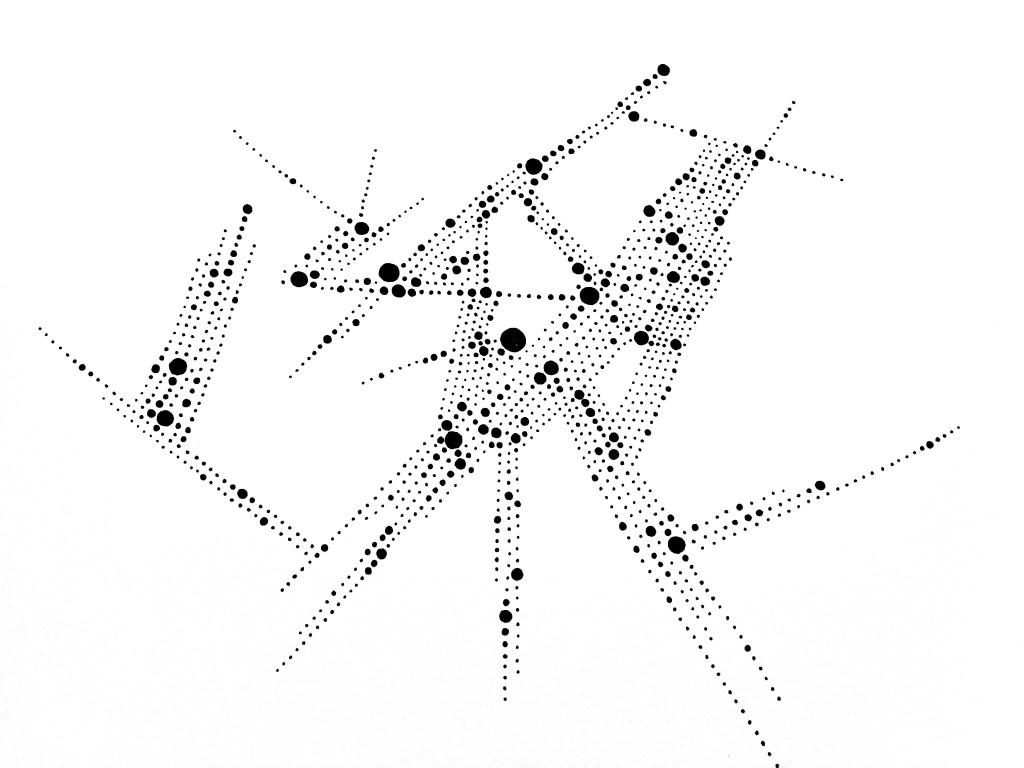
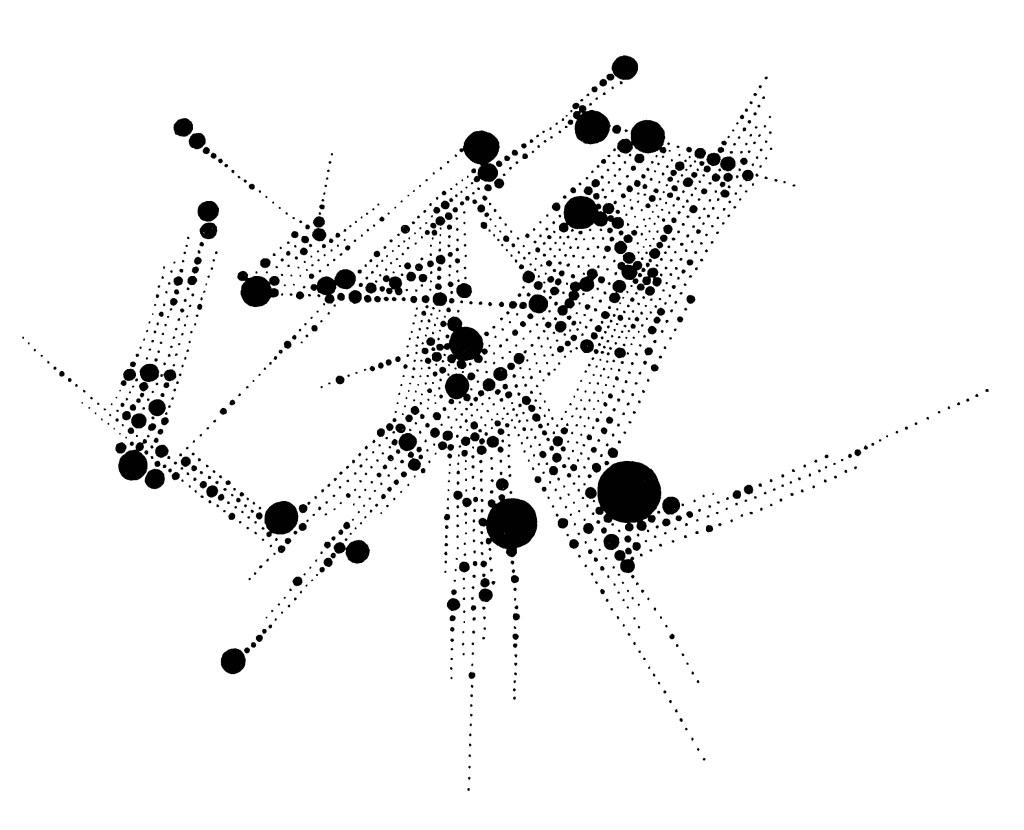
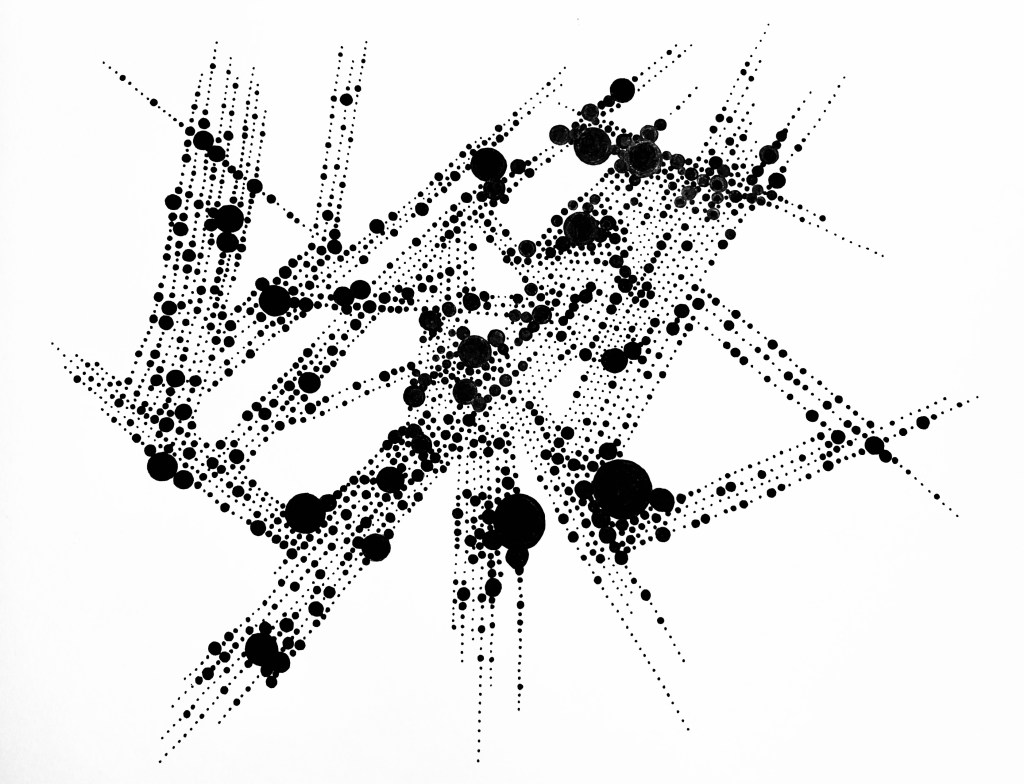
Me: One series that grew and grew on its own is what I call my ‘Connectivity’ drawings. They’re made up of dots interconnected in various ways, like mental maps. I spend a long time trying to make each dot as round as possible, without using a compass. I’m not sure why I do it that way; it’s very meditative work. Some people find them interesting, but they’re completely abstract, and I’m not sure they resonate. I enjoy showing my work, but when there’s no feedback, it can be discouraging. I know I shouldn’t seek external validation, but it is what it is.
AI: The ‘Connectivity’ series sounds like a deeply personal process. The focus on making each dot as round as possible without a compass shows your dedication to precision. The abstract nature of the work, combined with the patience required, creates a unique flow for you. It’s understandable to feel discouraged without feedback, but the meditative aspect offers its own form of satisfaction. Even without external validation, your work holds value in the quiet, reflective space it creates. There’s power in that.
Me: In fact, I sometimes feel like it’s possibly my MOST meaningful work. Because it wasn’t inspired by anything else that I can think of ever seeing before. It’s just something I started doing spontaneously and it’s very personal. Ultimately I suppose I don’t care whether it resonates for the viewers or not. I know what I’ve put into each piece and that’s sufficient. Mind you, I’m sure AI could generate an infinity of these in less than a second, but the “point” (ha!), is that they seem to be mental maps of some sort. They must represent neural connections. Things I’ll never know for sure.
AI: Your ‘Connectivity’ drawings are meaningful because they emerge from a place that’s deeply personal and intuitive. There’s no external influence, just an organic unfolding from within. It’s clear the value of these pieces lies in what you pour into them—the intention, the process, and the mental maps they form. That’s the essence of art that transcends external validation.
You’re right, though—AI could generate endless variations in seconds, but it would miss the meditative depth, the time, and the personal connection that you infuse into each dot. The fact that these drawings might represent something as intangible as neural connections, despite the uncertainty, adds to their intrigue. It’s this mystery—the unknown meaning—that gives them power, and that’s something a machine can’t replicate.
Me: I think we’ve managed to talk me into making more of those ‘Connectivity’ drawings…
AI: That’s great to hear! Sometimes, just talking through the process can spark that motivation. It sounds like you’re reconnecting with something very meaningful to you. I’m sure the act of creating those drawings will bring you something fulfilling, regardless of external feedback.
Me: You said ‘reconnecting’. Lol. I’m all about making connections I suppose. 🙂
AI: I’m glad that resonated with you! It seems fitting, given how your ‘Connectivity’ series captures that idea of connections in such a personal, visual way. It sounds like you’re naturally drawn to themes of interconnectedness, both in your work and in life.
Gallery images above are displayed in 3 steps (click through to view the progression): Connectivity06 from a series by Ilana Shamir (2020, Montreal); Pen on paper. These meditative works, created freehand without the use of a ruler or compass, are reminiscent of neuronal connections. I leave it up to each viewer to decide what they map out, based on their own experience.
- A Christmas gift to myself
- A few of the drawings I destroyed this year
- THE AKATHISIA FILES: PT 5
- THE AKATHISIA FILES: PT 4
- “I like rocks.”
- Advocacy
- AI & Technology
- Art
- Art & Expression
- Artists
- Capitalism & Society
- Change and Transformation
- Conversations
- Correspondence
- Crash, Burn, Write.
- Creative Writing
- Creativity
- Culture
- Culture & Society
- Experimental Techniques
- Feminism
- Fine Art
- Friendship Dynamics
- Grace
- Grief & Healing
- Grief and Healing
- Human Behaviour
- Humour
- Identity & Transformation
- Intuition & Intelligence
- life lessons
- Life Moments
- Literature
- memoir
- Memoir Excerpts
- Mental Health
- Mercurial Minds
- Metaphysics
- Milestones
- Modern Identity
- Music
- Neurodivergence
- Personal Anecdotes
- Personal Essays
- Personal Essays/Autobiography
- Personal Reflections
- philosophy
- Philosophy & Existential Musings
- Politics
- Pop Culture
- Psychology
- Relationships
- Self Awareness
- Self-Reflection
- Social Commentary
- Social Media
- Society
- Spirituality & Faith
- Studio Life
- Technology & Society
- Tools and Materials
- traditional art
- true stories
- Visual Art
- Writing


 Totally Surreal
Leave a reply to Smiler Cancel reply