
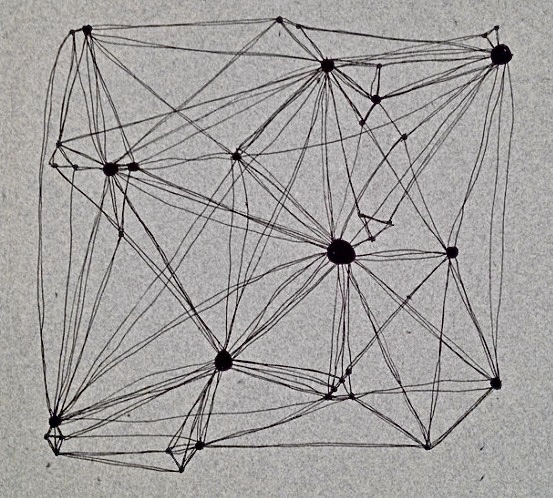
“Mapping a Nonlinear Mind”
Pen on paper, October 3, 2012
(Experimental Drawing class)
What looks like chaos to a linear observer is often an intricate architecture of connections — one idea branching into another, meaning travelling through intuition rather than order. Psychiatry calls this “disorganized thinking.” I call it pattern recognition by a creative mind.
A reflection on imagination, trauma, and the failure of one-size-fits-all medicine.
Our current psychiatric model, based on the DSM—the Diagnostic and Statistical Manual—is built around fitting individuals into statistical norms, and is too often punitive toward anyone who doesn’t conform to those parameters. Artists, creatives, and neurodivergent individuals are often misunderstood, misdiagnosed, and treated as mentally ill.
By contrast, psychiatrist Carl Jung, once a student of Sigmund Freud, understood that imagination, symbolism, and self-reflection are not symptoms of illness but pathways toward healing. His approach would be far more suitable for someone like me, because it aligns with both my cognitive style and the way I was raised.
The modern DSM framework favours linear thinkers—those whose thoughts proceed step by step, who value predictability and measurable outcomes. But nonlinear thinkers—those whose minds move through metaphor, intuition, or associative leaps—are often pathologised for what is simply a different mode of intelligence. What looks like “racing thoughts” to one observer may be rapid pattern recognition to another. What appears as “tangential speech” may be a mind mapping multiple dimensions at once.
Linear systems label what they can’t measure. And when medicine mistakes imagination for madness, the cost is human potential.
 Totally Surreal
Let me know what you think!