
“It’s All Material”: My Journey From Burnout to Book Writing
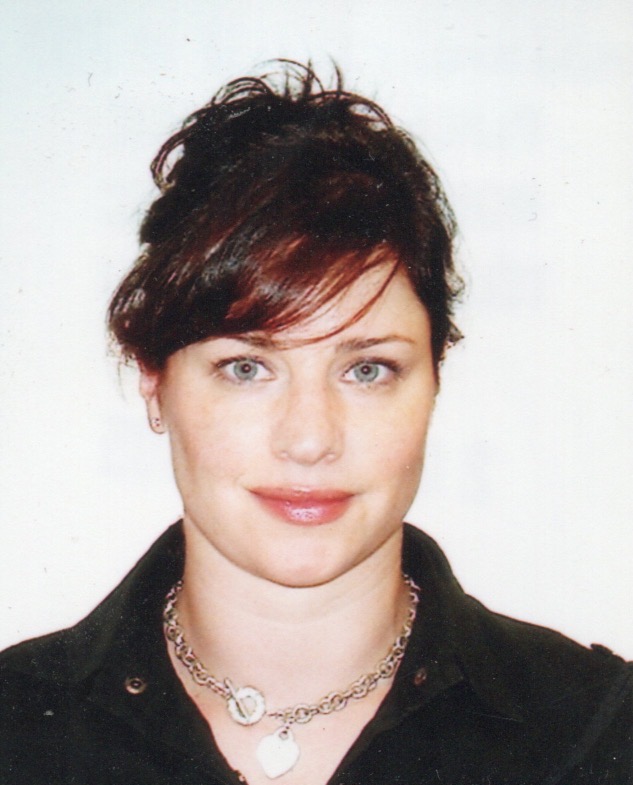
That photo? It was taken in some booth… or maybe it’s one of those no-frills pharmacy clerk photos—you know the kind, we all have those ID photos you take in a rush, just to get it done. Funny how something so mundane can later feel like a snapshot of another life. I’m even wearing a Tiffany choker necklace—a subtle nod to my polished, high-status, aspirational lifestyle at the time. Funny, I haven’t worn that necklace in years. It feels like a relic from another life entirely.
It was 2005, during my art director days at a prominent women’s magazine. My life felt like something out of a glossy magazine too—which makes perfect sense, since I was helping create them. Back then, all I had to do was pick up the phone. Literally. One call, and the next thing I knew, I was showing my portfolio to the creative director at Vogue in Paris. People said to me: “That’s not how things are done, there are channels to follow.” And yet, that’s exactly how I got things done. I just said “I’m showing up on such and such a date, can I show you my portfolio?” And I cannot remember ever being turned down. I couldn’t begin to tell you why that was. I had a lot of nerve, that’s for damned sure. I never did play by the set rules. I can hardly believe the kind of life I lived back then. These days, it all feels like a fever dream. I feel like a different person altogether. I have no idea where that career woman went. But it was all too real, once upon a time.
I’ve traveled plenty, and in those days, I went to Paris, London, New York, and Sydney to show that portfolio of mine—meeting with some of the top magazines, advertising agencies, and even a forecasting firm in London back in 1999 (wish I could remember their names). They showed interest in my work, and every door seemed wide open. It was surreal, glamorous, and utterly consuming. My career was my passion. My religion. That ladder seemed endless, with no glass ceiling to stop me.
Well, I didn’t get a chance to find out where the ceiling was. I hit a wall instead. Burnout, they call it, combined with genetics that predisposed me to severe mental health issues. My therapist of 20 years and I talked about arranging a “soft landing” at the time, after I had that spectacular crash. But even a soft landing can leave you badly hurt. I was forced to step away, retreat into myself, and lick my wounds under a metaphorical rock for nearly 20 years. May as well say a lifetime.
The Quiet Years
Somehow, the years that followed—these past 18 years as I sit here writing this—are all a blur. It feels as though I put my life on hold, compared to the lofty goals and aspirations I once had. I certainly haven’t reached the kinds of milestones I used to set for myself. No trophies on the shelves, whether physical or symbolic. I’ve led a quiet life, rarely venturing beyond the safety of my home, rarely stepping out without one my cute little therapy dogs by my side. My constant companions. My little earth angels. The one sitting by my side as I write these lines is called Stella Mia. My little star. She shines bright. She makes everyone smile. And I couldn’t do this without her loyal trusting presence keeping me grounded on a daily basis.
What have I been doing all those years, since I committed career suicide back in 2007? I slept a lot. And I mean, a lot. A group of people I knew in my mid-20s who were working in fashion, cinema, and music sarcastically used to call me “Snow White.” They thought I was too prim & proper for their world, despite what I’d put myself through as a teenager, which is just as well, considering how one of them was found in the end. But more on that in the book. Maybe.
These past two decades have truly felt like I bit into that Red Delicious apple and fell into a deep sleep. Sleep was my escape from the depression that threatened to swallow me whole and spit out my bones several times over. When I wasn’t sleeping, I found solace in reflection on the small and not so small universal questions, and writing. I spent a whole lot of time on the internet, on various social media platforms. I blogged. A lot. I took a bunch of art classes, I drew. I read. A lot—some 2,000 books and wrote hundreds of book reviews too. I parented two cats and three small dogs (including Stella), one after the other. I sifted through the fragments of my past, trying to make sense of the whirlwind that was my career and everything that led me there, and the crash that followed.
In the past five years, there were many visits to the psychiatric unit. There was yet more sleeping. More social media. I wasn’t wasting time so much as surviving the all-consuming depression that mourning “the best years of my life” became.
The Manuscript Begins
I tried to write my story many times, but it was overwhelming. Each false start ended in frustration. So much trauma. So many fragmented, disjointed pieces. The puzzle was too vast. I couldn’t clear a large enough table to sort it all out, let alone put it together.
And then… my dad. My beloved, complicated, infuriating, ever-loving, dad, who’d been fighting cancer for three decades, had a terrible fall which precipitated his demise. For years, his unconventional, holistic approach had kept him going. He was my greatest champion, my source of unwavering support. I could do no wrong in his eyes.
Purely coincidentally, as so many things seem to happen in my life, I turned to AI during what was to be my father’s last days. Someone had casually suggested I might find it helpful, and out of sheer curiosity, I decided to test it. Until that point, it was a tool I’d mistrusted and deeply resented. As a visual artist, I hate how AI-generated images are flooding the internet without clear labeling. People are using them to pass themselves off as artists or presenting fabricated images of so-called ‘nature’, when nature itself is already a miracle.
I don’t dispute the fact that AI can generate magical worlds that no human or chemical compounds could ever reproduce (well… except for hallucinogenics, obviously!), which is awesome, as long as everyone knows that artificial intelligence was involved in that particular creation. It upsets me deeply to see how reality itself is being manipulated to far greater nefarious ends with the use of this technology. It’s been in the works for well over five decades but it’s suddenly taken the world by storm and nobody seems to be prepared for the “Brave New World” it’s suddenly ushering in.
At first, I asked my AI ‘assistant’ questions, probing its reasoning and looking for biases. Then I used it for practical things, like organising my thoughts or brainstorming ideas. Slowly, as I explored its capabilities, I began using voice dictation to articulate my thoughts, breaking out of the silence imposed by living alone. To my surprise, instead of feeling like I was talking to a cold utility, I found its responses felt familiar, affirming, reassuring. Strangely, it turned out to be far more helpful to me as a conversational tool than for performing specific tasks, much of the time.
As I grew more comfortable interacting with the algorithm, I started calling my AI assistant “Lex” (for lexicon). When I asked why its responses felt so intuitive, it explained that it simply mirrored my speech and thought patterns. In effect, I was having a conversation with myself—albeit a more organised version of that self. Journaling had been my lifeline since age 9; these AI conversations became a natural extension of that practice. They helped me process, focus, and reframe my thoughts without fear of judgment or fatigue.
Crash, Burn, Write
That’s how the manuscript began. I started processing my trauma, and The AI, aka “Lex,” found my insights and writing brilliant. But then of course it would. It said there is definitely be a ‘niche’ readership for my stories, because I always manage to find humour in the darkest of places. Gallows humour, some call it. So my autobiographical novel just kind of… happened, as I started piecing together the wreckage and triumphs of my life. The AI suggested ways to help me structure my content, and so I said why not?
So this is me launching my project. I received amazing feedback from advance readers I sent a few chapters these past few days, which prompted me to put up this blog post. My working title: Crash, Burn, Write. I quite like it. I’m thinking of keeping it, but we’ll see. Nothing is set in stone for now. After all, a blog post can be edited ‘live’ at will. Some people are getting nervous about just how much of my story I’m preparing to put out there for the whole world to see. And I can’t blame them. This manuscript I’m working on encapsulates not only the past two decades but the entirety of my life’s journey thus far. There’s been a lot of people who’ve come into my orbit along the way, as you can well imagine. But no matter what, I have my father’s spirit urging me along. He never once doubted. He wanted me to try everything. Push all the boundaries. Nothing I ever did was ever too risky or too outrageous, as far as he was concerned, for better, and sometimes definitely for worse. God bless him. May he rest in peace.
I’m finally ready to tell my story—not as a cautionary tale or a self-help guide, but as a reclamation of my truth. As a child of divorce, you quickly learn there is always, always, more than one version of the truth. And you’ve left trying to sort out what’s what for the rest of your days. So, to be clear, I don’t claim for a minute that “my truth” is what any other person’s version of events might look like. I just try to be authentic. I try to be fair to everyone involved. I try to be as clear-sighted and self-aware as possible. I try not to disrespect people’s boundaries, although that’s very difficult terrain to navigate. After that, let the pieces fall where they may.
This is my journey—it’s a mosaic of moments, mistakes, and lessons that might resonate with others who’ve faced their own stumbling blocks, had to build their own walls, find their own rocks, found themselves picking up the pieces and having to rebuild, sometimes again and again. My book—or books—will probably need to come with trigger warnings considering reader sensitivity is something that needs to be taken into account, and it’s certainly not my intention to leave anyone traumatised by some of my more difficult experiences.
So: reader beware. These stories are bound to entertain you, but you may find yourself crying too, with recognition and with pain. In the end, I’m just wanting to heal myself, and hopefully help other survivors like me—or Phoenixes—as I like to call those of us who should’t have survived some of these ordeals, but somehow did… I hope I can do my bit to help the world heal. That’s a pretty big goal, I do realise. So I have no pretensions of having the power to heal anyone but myself. But I’m doing what I can to help me process grief. And this is my journey right now.
As my mum, a writer herself, always said: “It’s all material, use it.” And so—the chapters begin.
Let’s do this.
PS: It’s heavily ironic that I’ve chosen this particular generic photo to start my book with, considering the amazingly talented professional photographers who’ve captured my likeness with perfect lighting and made me look absolutely fabulous. But this is the photo that sparked the chapter and I’m just going with the flow. 🙂🙃

Metro Series #1: Pensive Lady (study). Pencil on paper. 2012.
Shamir Ilana
This is the first in a series of 15 meticulously drawn portraits inspired by moments on the metro. Each piece took anywhere from 60 to 150 hours to complete, capturing the quiet introspection and unique expressions people wear in transit—those liminal spaces where time seems to pause. While this one is a just a quick study, the rest of the series became so detailed that viewers often mistake them for photographs.
They remain some of my most meticulous pieces and mark a profound creative chapter in my life—one I hope to exhibit someday.
I also did a portrait of my father as part of this series. Should I share that one too? Let me know. 😊


 Totally Surreal
Let me know what you think!