
A wise woman once said “fuck this shit” and she lived happily ever after
~ Anonymous
It wasn’t until last night, while I was writing this section of my as-yet-untitled autobiographical novel, that I fully realized how much the dissonance of those days on the beach mirrored the song Everything In Its Right Place by Radiohead. I had been listening to this 1990s band when this song came on, and I ended up playing it on a loop while I composed this section of my upcoming book. This post is Chapter 1, which is part of a larger section comprising six chapters. Without even realising it, the song captured the sense of disconnect I was trying to convey—the strange combination of confusion and connection I had experienced back then. A friend of mine, Thom, who’s been reading parts of my manuscript and offering feedback, described the song as “contemplative,” with a “droning” quality that perfectly matched the quiet uncertainty of those moments.
Chapter 1: On the Beach and What Came After
It all began with a conversation I had with my mother, shortly after my 10th birthday. She had a plan which seemed at once thrilling and uncertain. She suggested we go on a three-month backpacking tour of Europe, something she thought would appeal to my growing interest in discovery. The idea was simple enough: a Eurail pass, freedom to move from one city and one country to the other without any set plan or itinerary, just being guided by inspiration and happenstance. Wandering and discovering things as you go. It sounded wonderful. I’d always wanted to discover Europe. All of ten years old, I already felt I had an affinity for that continent. Probably because of my Polish ancestry. But my curiosity quickly turned to anxiety.
“How long will we stay in each place?” I asked, needing to know the details.
“Where will we sleep?” was the bigger question. I couldn’t imagine a journey without knowing where I would rest my head each night. I was visualising a pillow as I asked that question. Wanting to know what texture that pillow might have from one resting place to another.
She reassured me: we’d stay in youth hostels, sometimes with locals, and if need be, on park benches, although I’m pretty sure she said that part in jest.
But the uncertainty was too much for me. So my mother offered me a choice to make me feel at ease: “You can come with me, or you can stay with your father in Israel if you prefer.” I decided that Israel with my father would offer some kind of stability. At least I’d know where I was staying from one day to the next. I’d lived on a kibbutz with my father a couple of years before but that was a distant memory by then. I was already familiar with the language. I chose to stay with my father.
And just like that, I was on a plane to Israel. Flying as an unaccompanied minor, as I did several times during my childhood. I can’t remember any details of the flight or of landing at Ben Gurion airport. I just remember being in Eilat, a resort town on the shores of the Red Sea. I remember standing on the beach, looking out to the Red Sea—which to this day is a popular SCUBA diving resort—being keenly aware that to my right, lay Egypt in the east, and to my left to the west, Saudi Arabia. For me, as a 10-year-old, geography held a strange fascination. I would often look out at the water, aware of the proximity to those distant lands—countries I only knew through maps and stories. My father and I were living in a tent, on that beach amid many others, surrounded by young Europeans who were backpacking before settling down to serious studies or jobs and family life. It was a community of wanderers, hippies, and dreamers, living their own version of utopia.
My father, who spoke at least seven languages, was looking for work as a hotel clerk since there were many major hotels who were constantly hiring. For some reason, this job search took a long time, though I couldn’t say how many days or weeks… the days on the beach flowed into one another and I was simply living in the moment. My dad would leave each morning, and I’d find all kinds of things to occupy myself with. One of my favourite activities was picking up cigarette butts from the sand. I hated cigarettes with a passion and they littered the ground by the hundreds of thousands and I felt I could do my small part to ‘clean up the planet’. I would comb the beach for hours, making the sand cleaner, while my father looked for work.
Then, there was Marilou. She was a Dutch girl, no older than 19, in her black tiny bikini, with sun-kissed skin, long blonde wavy hair, and blue blue eyes. We took an instant liking to each other, and we chatted for hours. I can’t imagine what we had to say to each other, but she seemed to really like me and the feeling was entirely mutual. She had a boyfriend—an Israeli soldier, deeply tanned, with dark eyes and hair trimmed very short. He was a stark contrast to Marilou, his dark skin a deep bronze next to her pale, lobster-red complexion.
One memory that sticks with me is a snapshot my father took of me wearing the t-shirt I chose to have printed with a design of a single red roses. It was a large black t-shirt which reached down to my knees. I’d chosen the design from one of the tourist shops which specialised in heat transfers, which were popular in the 70s and 80s. The walls were lined with t-shirts and various design options. I took my time deciding on the t-shirt colour and design combination. Now I think of it, it was a strange choice, considering how young I was and interested in all things ‘girlie’ still, with an affinity for pinks and pastel colours. I hadn’t yet discovered hard rock or its imagery, but there was something in the act of choosing it that feels significant in hindsight.
That photograph captured me sitting on the beach, my knees at an odd angle, a variation of a yoga pose. My father was a regular practitioner and I often accompanied him in his practice, doing my own version of yoga ‘light’. I was a carefree child, smiling happily seemingly without a care in the world. The remnants of the bowl cut my mother had given months before framed my face, and I seemed happy and carefree, as any child that age should be.
Living on the beach wasn’t as strange as you might think. It was 1979, and the beach had a vibe of its own. The community of travellers, the simplicity of days spent by the sea—it was an adventure. We took showers in outdoor facilities, and my sunburn was one of the worst I’ve ever had. The blisters that formed on my back stayed with me for weeks after.
Despite the unpredictability of life on the beach, the strange mix of freedom and discomfort—I was happy enough in my own way. But of course this was a place of transition and my father wanted to find us a place to live, so we could at least have a roof over our heads, if not a more permanent situation, and that’s when things began to get sticky, though undoubtedly interesting as well.
End of Chapter 1
The next chapter will appear in an upcoming blog post: “The Eye on the Wall.”
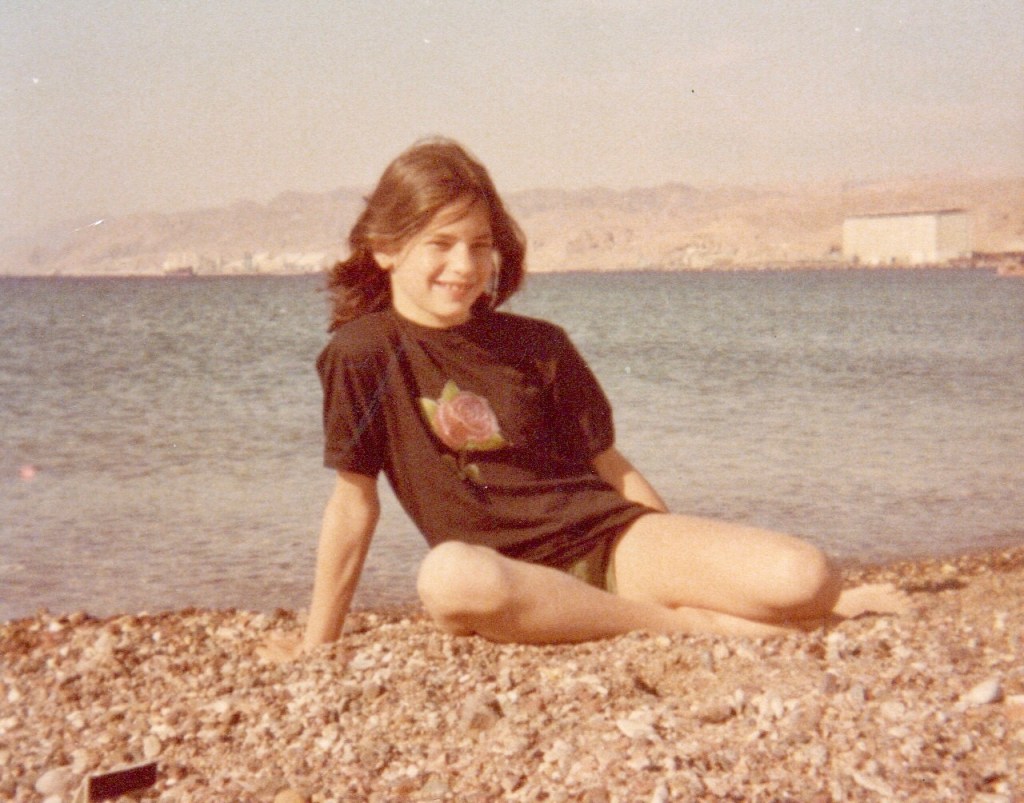
Me, at age 10, captured by my father on the beach in Eilat, 1979.

 Totally Surreal
Let me know what you think!